The Billion-Dollar Moonshot: Washington’s High-Stakes Gamble on “Unproven” Rare Earths

The Billion-Dollar Moonshot: Washington’s High-Stakes Gamble on “Unproven” Rare Earths
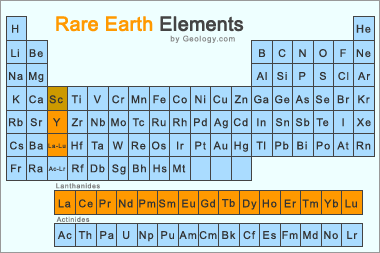
For decades, the United States watched from the sidelines as China quietly built a global monopoly on the 17 elements that make the modern world spin. Now, facing a “Two-Month Reality”—the terrifying estimate that U.S. strategic stockpiles would last just 60 days in a full-scale supply cutoff—Washington has stopped playing it safe.
IMG source : https://geology.com/articles/rare-earth-elements/
The strategy has shifted from cautious subsidies to a full-blown venture capital-style gamble. The U.S. government is currently pouring billions into “unproven” players, hoping that a few high-risk bets can break the Chinese “chokehold” before a 2027 federal ban on Chinese-sourced minerals in U.S. weapons systems takes effect.
—
The “Two-Month” Panic
In early 2026, the rare earth market shifted from a slow burn to a wildfire. After China restricted exports in response to new trade barriers, shipping volumes to the U.S. plummeted by 22.5%.
For the Pentagon, this isn’t just about consumer electronics; it’s about survival. Rare earth elements (REEs) like dysprosium and terbium are the “secret sauce” in:
Missile Guidance Systems:
Precise targeting requires high-performance magnets.
Stealth Fighters:
Specialized coatings and components.
Satellite Communications:
Ensuring connectivity in contested environments.
With the January 1, 2027 deadline looming—after which no Chinese rare earths can be used in U.S. defense hardware—the government has entered “whatever it takes” mode.
The Players: From Startups to Titans
The U.S. is no longer just funding established giants like MP Materials (which operates the Mountain Pass mine). Instead, the Department of Commerce and the DoD are cutting checks for companies that have yet to produce a single commercial ounce of refined material.
1. USA Rare Earth: The $1.6 Billion Underdog. The poster child for this new strategy is USA Rare Earth.
Despite having no commercial mining or magnet production today, the company secured a $1.6 billion package from the Commerce Department’s CHIPS Program in early 2026.
The Goal: Build a “mine-to-magnet” platform.
The Risk:Its flagship Round Top deposit in Texas is notoriously low-grade and mineralogically complex. Commercial production isn’t expected until late 2028—nearly two years after the 2027 ban kicks in.
Vulcan Elements and Re-Element Technologies
In late 2025 and early 2026, these two startups became the latest beneficiaries of the “Project Vault” initiative.
Vulcan Elements:Received a $620 million DoD loan to scale up magnet manufacturing.
Re-Element:Bagged $80 million to focus on “circular” supply chains—extracting rare earths from recycled magnets and battery scrap rather than traditional mining.
Why Is It a Gamble?
If this sounds like the government is acting like a Silicon Valley VC, that’s because it is. Critics and analysts point to three massive hurdles that could turn these billions into a “money pit”:
| Challenge | Reality Check |
Technical Complexity | Separating rare earth elements is a chemical nightmare. China spent 30 years perfecting the “black art” of REE processing. |
|Price Volatility| China can flood the market at any time, crashing prices and making high-cost U.S. startups uncompetitive. |
| Environmental Costs | REE refining is historically “dirty.” U.S. players must comply with strict EPA standards that their Chinese competitors often bypass, driving up costs. |
“This administration is willing to take greater risks,” says Heidi Crebo-Rediker of the Council on Foreign Relations. “Rather than seeing whether the government can afford to lose this money, the question has become: Can we afford not to spend it?”
The Tech Play: Digital Twins and Hydrometallurgy
To bridge the expertise gap, the U.S. is leaning on tech. USA Rare Earth is currently collaborating with the National Energy Technology Laboratory to develop “digital twin” technology. This allows engineers to simulate the complex separation process in a virtual environment before building physical refineries, theoretically cutting years off the development timeline.
Bottom Line: Moonshot or Bust?
The U.S. is essentially trying to build a 30-year industry in under 36 months. It’s a high-stakes, high-cost race against a ticking clock. If USA Rare Earth or Vulcan Elements succeed, the U.S. regains its industrial sovereignty. If they fail, the billions spent will be a footnote in a story about a supply chain that stayed broken just a little too long.
As we move deeper into 2026, all eyes are on the Colorado hydrometallurgical facility, set to commission in Q2. If those first samples of refined oxide meet the grade, Washington might just win its biggest bet yet.
Do you think the U.S. should focus more on recycling existing rare earths or continue the heavy investment in new domestic mining projects?